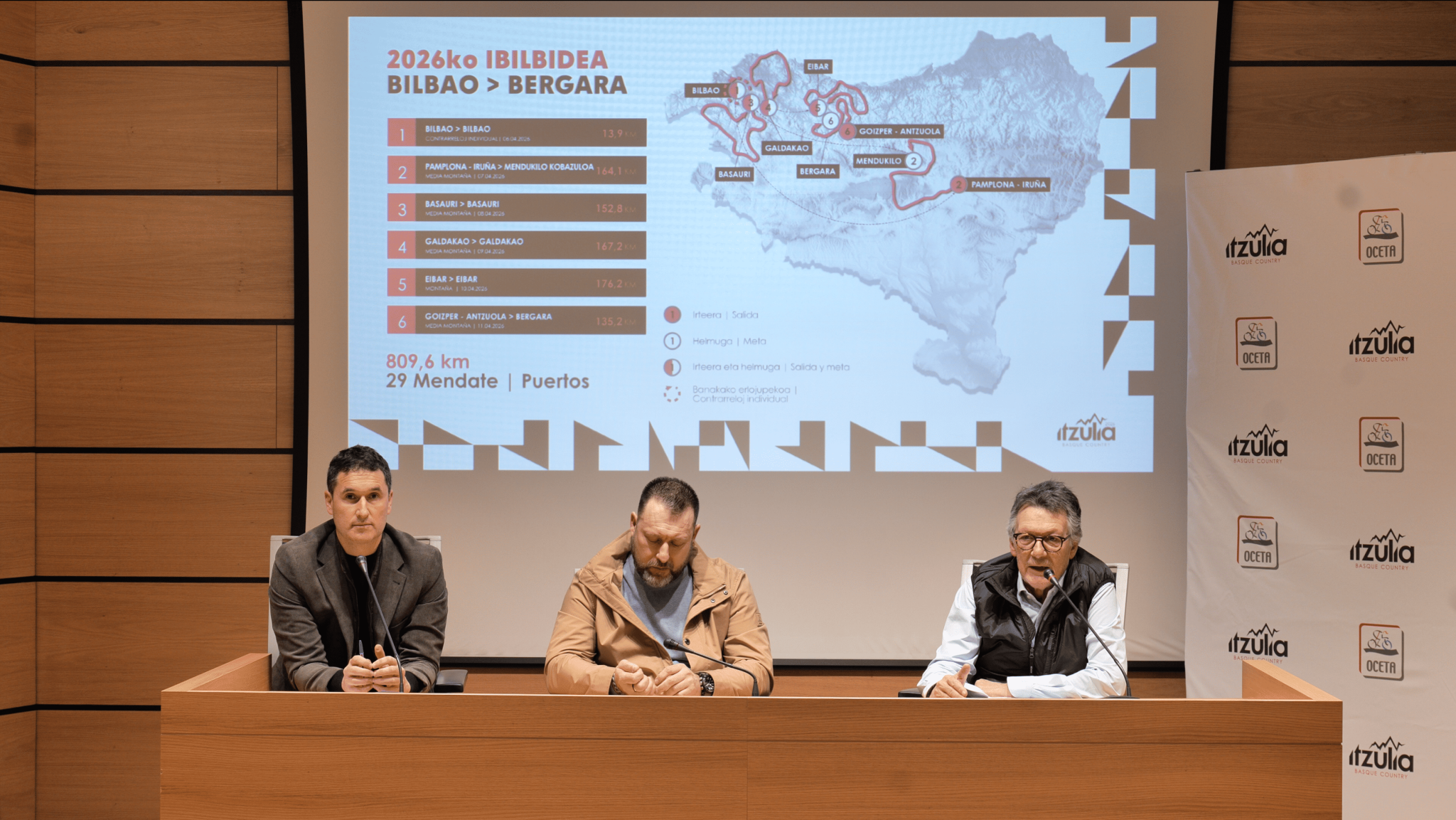
The race will take place from 6 to 11 April, comprising six stages, starting in Bilbao and finishing in Bergara.
Today, the official route for the 2026 Itzulia Basque Country was presented in Eibar, with an edition that once again places emphasis on toughness and consistency. The event was attended by Eibar’s Councillor for Sport, Andoni Ameztoy, and OCETA President Javier Riaño, at a press conference held to unveil the details of the race.
The 2026 edition will take place from 6 to 11 April and will feature six stages, covering a total of 809.6 kilometres, with more than 16,154 metres of accumulated elevation gain and 29 scoring passes, including four category one, seven category two and 18 category three ascents. A route designed for experienced riders, with no obvious transitional stages and mountains as a constant feature.
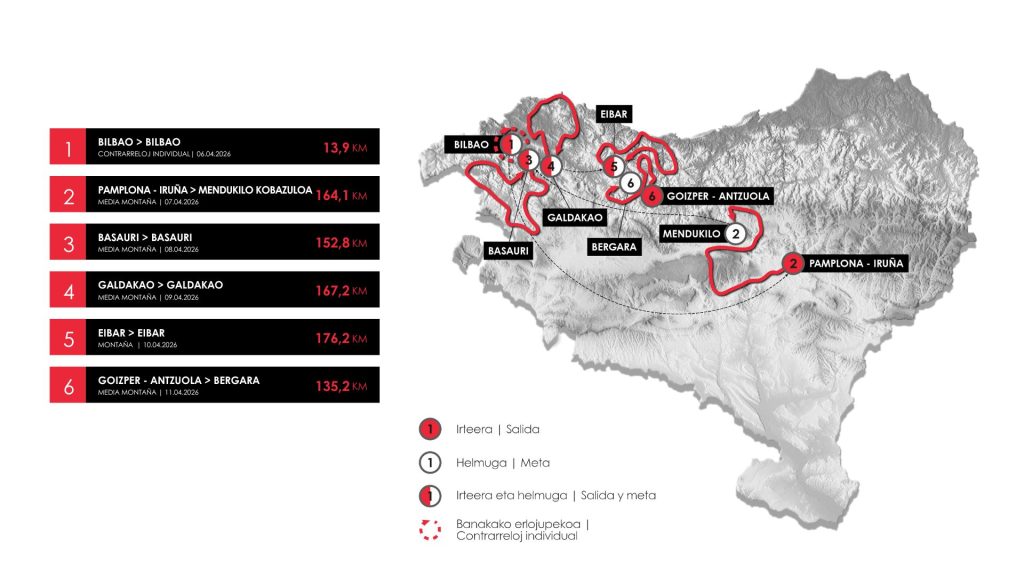
Stage 1 | Bilbao – Bilbao (13.9 km)
Short time trial
The Itzulia will kick off with a short individual time trial, ideal for setting the first time differences. After being held without spectators in 2021 due to the pandemic, the time trial is back. At 13.9 kilometres, significant gaps are unlikely, but the stage will mark the first rankings in the overall standings.
Strong riders and specialists could lead, while climbers look to minimise their deficits. It may not be decisive, but it will influence the strategy for the opening days.
Stage 2 | Pamplona – Cuevas de Mendukilo (164.1 km)
Challenging mid-mountain terrain
The second stage immediately tackles the Itzulia’s classic terrain. Boasting over 3,300 metres of elevation gain, the route is long and steady, without a punchy finale, yet marked by continuous strain on the riders.
The stage could favour well-organised breakaways, while teams vying for the general classification may look to assert control. While the favourites will need to remain vigilant, they are not expected to launch a decisive move at this stage.
Stage 3 | Basauri – Basauri (152.8 km)
A tense, action-filled day
An average-length stage, featuring almost 2,900 metres of elevation gain. The circuit-style route tends to produce a fast pace from the start, leaving little room for respite.
Breakaways could form at this point if the GC standings are unsettled. While not clearly decisive, the stage poses risks for riders who are poorly placed or backed by less capable teams.
Stage 4 | Galdakao – Galdakao (167.2 km)
A stage ripe for tactical manoeuvres
Boasting more than 3,200 metres of elevation gain, the stage requires riders to stay consistent and read the race well. The absence of a clear finish encourages attacks at intermediate elevations.
Teams with multiple riders in good positions can make the most of their opportunities. Accumulated fatigue begins to show, and the peloton’s natural selection will start to take shape.
Stage 5 | Eibar – Eibar (176.2 km)
The queen stage
The hardest day of the race. The 176.2 kilometres and 3,841 metres of climbing, combined with Eibar’s familiar terrain, make this a crucial day for the general classification.
Expect head-to-head attacks between the top favourites. An ideal chance to create decisive gaps and determine much of the final standings.
Stage 6 | Goizper-Antzuola– Bergara (135.2 km)
A tough finale to settle the general classification
The finale is no mere formality. Despite its shorter distance, the stage packs in nearly 3,000 metres of elevation gain, ensuring high tension right to the end.
If the general classification is close, it will be a day of constant vigilance. It could also provide an opportunity for one final long-range attack.
The 2026 Itzulia Basque Country, with this demanding design, promises no easy days, rewarding consistency, stamina, and the ability to read the race for riders targeting the overall win.